The Soviet Security Service and its treatment of novelists during the 1930s, by Polly Corrigan. Chapter 1: The Soviet security service in the 1930s
As with so much of the historiography of the Soviet Union, the scholarly debate over the security service in the time leading up to and during the great purges of 1937 is dominated by competing analyses of the extent of Stalin’s influence on these events from both the ‘totalitarian’[1] and ‘revisionist’[2] schools of thought. This section analyses these two approaches using methods developed within intelligence studies and utilising archival material.
While the security service has been portrayed as the cruel and indiscriminate weapon of a paranoid tyrant following his every whim in ‘spellbound submission’, [3] more recently, scholars have drawn quite different conclusions about the relationship between the Stalin and the security service. ‘
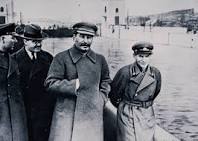
The OGPU and Stalin worked well together…’ [emphasis added] comments Sheila Fitzpatrick in her recent book on Stalin and his close colleagues. Acknowledging that the ties between the security service and the General Secretary were constant, she rejects the idea that any of the leaders of the service before Yezhov were truly loyal to Stalin.[4] In this chapter we will explore the nature of this relationship further – beginning with a formulation of the questions that will guide us through the rest of this chapter.
The Soviet security service and the debate on intelligence
Within the field, there is lively debate over what exactly constitutes intelligence – a debate that has been shaped by each new threat to national security as it has arisen over the last century.[5] A recent definition of the work of security service from one intelligence scholar suggests that their work is made up of tasks: ‘that states do in secret to support their efforts to mitigate, influence, or merely understand other nations (or various enemies) that could harm them’.[6]
In this quote we see, almost as an aside, a key phrase to help us begin to define the work of the Soviet security service: ‘various enemies’ – referring to the business of investigating Soviet citizens themselves. Intelligence scholarship is largely focused on the practice of purloining the secrets of other nations in order to bolster one’s own security with less focus on the surveillance done within a nation’s own borders. For the Soviet security service in the 1930s, however, such work a core element of the information they provided to the Politburo. The ‘enemy’ for the OGPU and its successor the NKVD was often living under their very noses, perhaps as a peasant, perhaps a composer of music, perhaps a factory worker, a typist, or an engineer. So at this point, a very great deal of intelligence theory – i.e. all that relates to the gathering of foreign intelligence – can be set aside. We must instead search for those parts of the theory that are applicable to domestic matters, and where that fails to be useful, perhaps make some tentative suggestions for new explanations.
Thus while several scholars place war, or the possibility of war, as a central factor in the need for intelligence,[7] when we examine the case of the Soviet Union in the 1930s this is not such a useful definition. As we are considering the domestic activity of the security service, it is clear that at this point the Soviet leadership were not at war with its own population. The civil war of the early 1920s was long finished, and there was no prospect of a new one. So there was no direct military impetus to gather intelligence about the Soviet population in order to win a war.
However, the question of an international war was clearly uppermost in the minds of Stalin and the Politburo during this decade, and this drove much intelligence activity abroad. And within the Soviet Union, particularly after the death of Kirov in 1934,[8] the security service expended a great deal of effort on identifying and eliminating ‘enemies’ who might be in league with the Soviet Union’s foreign foes.[9]
Yet this was not the only factor driving the need to collect intelligence about Soviet citizens in the 1930s. It certainly cannot begin to explain why the activities of groups such as writers came under such scrutiny. The need to simply observe the Soviet population, to try and gauge their attitudes, thoughts and feelings, seems to have been a major goal of much of the intelligence gathering of this period.[10]
To be sure, this intelligence might have produced evidence of plots against Politburo members, but much of it was far more mundane in character. As we shall see in chapter two, the focus of this intelligence was the responses of ‘ordinary’ Soviet citizens to current events. We might ask why the Soviet leadership felt the need to apprise themselves of such information. Several scholars have suggested the notion of lessening or managing risk as central to the definition of intelligence, and this interpretation may help us to understand how the intelligence provided by the Soviet security service to the Politburo was useful. For example, Wheaton and Beerbower define intelligence as ‘a process, focused externally and using information from all available sources, that is designed to reduce the level of uncertainty for a decision maker’.[11] A penetrating knowledge of your own citizens’ hopes, fears and thoughts may well help to minimize uncertainty, especially in a country where there is no democratic process to act as a conduit for popular opinion.
Two more scholars of intelligence, Gill and Phythian, take their analysis a step further. Borrowing ideas from Foucault’s analysis of surveillance as the state’s manifestation of power over its subjects, they suggest that state power, almost as an end in itself, is a key reason why states collect intelligence about their own citizens.[12] Two Russian historians, Kokurin and Petrov, echo this outlook in their study of the Soviet security service, in which they argue that: ‘terror was not an end in itself and not a ‘secondary consequence’ but one of the fundamental instruments… of all-round control and management.’[13] In contrast to this, Bozemann, writing on the problems of finding a general theory of intelligence that would fit every intelligence service in the world, suggested that the quirks of each national political system ultimately dictate the nature of their intelligence service.[14]
Therefore, despite the fact that the majority of intelligence theory focuses on foreign activity, there are several strands of intelligence theory that might be help us to formulate useful questions about the domestic activity of the Soviet security service. First is the state’s need to protect itself from potential enemies whether foreign or within national borders. Secondly, there is the state’s desire to minimize uncertainty, and perhaps even to control the population to some extent, clearly an important consideration when we come to analyse the relationship between the security service and the Soviet leadership. Lastly, there is the very national character of each security service: the possibility of the Soviet or Stalinist character of the security service of the 1930s.
In search of ‘Soviet’ security
The question of what was specifically Soviet or Russian about the Soviet security service in the 1930s is a complex one. A useful starting point might be to examine the terminology of intelligence, as it is rendered in Russian. In the English language ‘intelligence’ is used as a catch-all term for nearly all aspects of the activities of a security service[15], its root in the need for information. However, in Russian the word most often used is “razvedka”, with a small but significant difference in its origins. It is related to the word “razvedat’”, which means ‘to find out (about), ascertain’ and is more usually translated as ‘reconaissance’, although one historian of the Soviet security service argues that in fact no adequate translation can be found.[16] This difference in focus could also suggest a difference in approach between the two systems.
One intelligence historian, Reginald Brope concludes in his survey of the Soviet security service that it is roughly comparable with America’s CIA and the FBI combined, or the UK’s MI5 and MI6 – though with more resources[17] and with the key difference that that ‘its focus was the constant search for enemies among its own people on a national scale’.[18]
Another scholar has drawn a further distinction between Soviet and western security service suggesting that western security services collect intelligence in order to safeguard democracy whereas the Soviets used their intelligence to repress democracy.[19] While this may be true, it does not bring us closer to understanding the actual aims and decisions of the leaders of the Soviet security service, who would be unlikely to have stated this as their goal. Paul Gregory, in his study of the Soviet security service, also uses democracy as a device to define how the activities of the security service differ in the Soviet Union and in the west. Gregory agrees that democracies have political police with wider powers than the regular police to guard against internal enemies but contrasts this with ‘totalitarian regimes’, which lack judicial oversight and use more extensive definitions of who is considered an enemy. In such regimes, he says, it is usual for the security service to be personally guided by the dictator, rather than by a wider administrative staff.[20] While Gregory uses ample evidence to illustrate his theory, as we shall see, the reality behind matters such as the legality of the security service was not straightforward.
While Brope’s thoughts on the Soviet security service may suggest some differences between the Soviet and other similar security service, ultimately his argument is probably a little too simplistic. On a structural level, while it may be accurate to compare the Soviet security service to the CIA and FBI, both the foreign and domestic security service were divided up into strictly compartmentalised departments. Perhaps all security services share a level of bureaucratic complexity, however this is not confined to institutions of security, so it is a fairly basic comparison. Indeed, Kokurin and Petrov argue that the basic shape of a service divided into five main departments, and that this lasted through every transformation of the service from 1917 up until the last days of the KGB.[21]
In terms of its activities, while the focus on finding the enemy within may have been particularly fierce and protracted in the Soviet Union, the Soviets were by no means the only ones closely monitoring the activities of their own citizens including writers. In the UK, George Orwell and Doris Lessing were both watched by MI5 for more than 20 years.[22] Perhaps further comparison with other national security organisations will enrich our understanding of what is peculiarly Soviet about the OGPU and NKVD. A recent examination of the British intelligence system suggests that to truly understand what British Intelligence is, we must look at how the organisation works but also ‘at the underlying rationales behind its structure and how it fits within the wider governmental machinery’.[23] This assessment also includes a detailed breakdown of the ‘intelligence cycle’, made up of three stages: collection, analysis and dissemination, including a discussion about the organisations involved and the motives for each stage.[24] These questions could be usefully applied to the question of Soviet security to deepen our understanding of how they worked.
While it might be thought that another starting point for comparison is another Communist regime, analysts of Chinese intelligence systems suggest otherwise. There are in fact many points of difference between China and the Soviet Union. First, China has never used political terror against its citizens in a systematic way, as happened in the 1930s in the Soviet Union. The explanation one historian offers this runs as follows: ‘Because of the serious organisational weaknesses of the Bolsheviks, Soviet communists had to turn to the secret police to fulfil military and political tasks. This was not the case with the CCP [Chinese Communist Party].’[25]
China’s security service also differed in its structure from that of the Soviet Union, with China avoiding the Soviet model of ‘a vertical, hierarchical command structure that possessed an enormous number of paid and unpaid agents.’ It is suggested that this may be because of China’s age-old practice of cultivating close local ties between police and residents, or perhaps because of Mao’s preference for using ‘mass movements’ rather than the security service to ensure his authority.[26] It is also worth noting that the leaders of Chinese security service were never executed – a fate that befell Yagoda, Yezhov and Beria.
By contrast, and perhaps not surprisingly, there are more points of comparison between the Soviet and East German security service, or Stasi, as it is commonly known. Members of the Stasi referred to themselves as Tschekisten and were often trained within the Soviet Union itself.[27] Prime examples were Erich Mielke, head of the Stasi from 1957 until 1989, and his head of foreign intelligence, Markus Wolf, described as follows: ‘each was a thoroughgoing product of the principles of the Soviet intelligence system.’[28] However, while the Soviet influence may have been clear in the training and methods of the Stasi, there were clear practical differences between the Soviet and East German security service – in particular, the number of personnel employed by each service. Here, the contrast between the two is striking: ‘… at the height of the Great Terror… the NKVD had one informer for every five or six families in Moscow… But in the Ukrainian regional district capital of Kharkov, the Soviet secret police had one informer for every 16,800 people. The secret services of the USSR… did not even come close to the ratio in East Germany of one full-time secret police officer for every 180 East German citizens.’[29]
Another useful comparison is not geographical but temporal – with the Russian security service before 1917. Tsar Nicholas I established a new headquarters for his security service in St Petersburg, and this was to serve as the centre for the Tsarist security service, now known as the Higher Police, until the revolution of 1917.[30] Although several of the senior staff remained in post from the previous incarnation of the service under the reign of Tsar Alexander I, the increase in the levels of their activity can be judged from this complaint from one of the Higher Police’s own staff that it was now: ‘impossible to sneeze in one’s own home… without the Sovereign’s finding out about it within an hour.’[31]
It is instructive to note that even at this time, a hundred years before the revolution, there was tension within the Higher Police over the issue of censorship, with one faction wanting to liberalise what could be printed, and one group desiring ever closer control of what the public could read. And, just as so often in Soviet times, a committee was set up to examine the issue and rewrite the rules.[32]
But there were no differences between the Okhrana and the Soviet-era security service. In the years leading up to the revolution, Soviet-era historians proposed that the Okhrana had a network of 40,000 paid informers, more recent estimates put the figure at less than one thousand. Furthermore, while many Tsarist government employees remained in their positions after the revolution, the staff of the Okhrana was more fundamentally disrupted, with very few Tsarist agents joining the Cheka.[33]
The OGPU 1929 – 1934
The Soviet security service grew and expanded throughout the 1920s, undergoing several name changes and reorganisations. For Cristina Vatulescu, these names changes signify the sinister nature of the security service, intent on shedding its skin like a devious serpent:
‘The dizzying succession of acronyms that have stood for the Soviet Secret Police (CHEKA, GPU, OGPU, NKVD, NKGB, MGB, MVD, KGB) speaks on the institution’s attempts at creating a new language that does not reveal its referent but rather mystifies it.’[34]
Whether the shifts within the security service indicate an attempt to bamboozle the Soviet population or not, it is true that during the 1930s the Soviet security service were in a state of almost permanent revolution in terms of personnel, powers and activities.[35] To understand the implications of this change on the security service, let us now examine in more depth the evolution of the security service during the 1930s.
Notable developments during the 1920s had included the setting up of extra-judicial bodies, or Special Boards, with the power to put on trial and punish citizens suspected of anti-Soviet activity.[36] The security service had also overseen the creation of a network of prison camps, known as the Glavnoye upravleniye lagerey (Main Camp Administration), shortened to Gulag.[37]
As the 1930s began, the first five-year plan was underway at the same time as the process of collectivisation in rural areas of the Soviet Union. The role of culture in Soviet society was also undergoing massive and thorough changes – in a very political manner in line with other social changes taking place.[38] For Soviet writers, this signalled significant change. After a degree of factionalism within the literary community during the NEP period, the Russian Association of Proletarian Writers (in Russian, Rossiskaya Assotsiatsiya Prolertarskikh Pisateley or RAPP for short), had been set up in 1928 following a resolution of the Politburo on the question of writers’ organisations.[39] RAPP was initially favoured by the Soviet leadership because of its perceived ‘non-Trotskyite’ leadership. [40] However by early 1929, there were signs of growing dissatisfaction with the output of RAPP’s writers at the very highest level as this letter to RAPP’s writers from Stalin makes clear – using a series of rather odd military metaphors: ‘The problem is… that RAPP doesn’t know how to build a literary front properly and to array its forces on this front in such a way that victory comes naturally from a defeat… A military leader who doesn’t know how to take into consideration the characteristics of all these diverse parts and utilize them variously in the interests of a unified and indivisible front – forgive me, Lord, but what kind of a military leader is that? I’m afraid that sometimes RAPP resembles just that kind of military leader.’[41] [emphasis in original]
At around this time, Sergei Tretiakov, a journalist and friend of Sergei Eisenstein, began to put forward his ideas of a ‘Literature of Fact’, a precursor to Socialist Realism, which would prioritise ‘utilitarian’ writing over established, more bourgeois, forms of writing.[42] However, it was the Union of Soviet Writers, created in 1932 with the writing of a a programme for Socialist Realism, that provided a useful tool for the security service to both collect intelligence and suppress opposition.
Meanwhile, the Cheka, set up under the leadership of Felix Dzerzhinsky, had been reorganised in 1923, and renamed the OGPU. After the death of Dzerzhinsky in 1926, V.R. Menzhinsky had taken over as OGPU chief. Menzhinsky was himself a published novelist and sometime poet.[43] However, if other writers thought that this fact might have predisposed the new OGPU chief to behave sympathetically towards those of an artistic bent, they were wrong. One of his early actions in his new post was to overrule Lunacharsky and ban Bulgakov’s play ‘The Day of the Turbins’.[44]
By the turn of the decade, the organisation over which Menzhinsky presided was certainly powerful and large. Order number 282, issued in 1929 by the OGPU, set out the new structure of the service.[45] Under Menzhinsky was a collection of deputy-chairmen, secretaries and other second-tier staff, including Yagoda, made up of around 18 men. A further 2409 staff ran the OGPU central apparatus, and these staff oversaw the running of seven different departments, each with its own head and divided up into several sub-units:[46]
I – Secret-Operative Affairs
(divided into seven departments: Secret dept, Counterintelligence, Special dept, Info and political control, Operative, Military regions, Central registry)
II – Fire Safety and Military
III – Economic Affairs (10 depts)
IV – Special dept (8 Depts)
V – Foreign affairs (2 departments)
VI – Transport (4 departments)
VII – Admin-organisation (13 departments)
In terms of numbers of actual personnel, the most recent information suggests that in 1930, the OGPU employed 17,298 staff, which rose to 25,573 staff by the middle of the 1930s.[47] Along with a new structure came measures to keep that structure secret. An order in 1929 instructed OGPU employees to withhold the department that they worked in when filling in official forms and simply to write ‘Employee of the OGPU’ in case these forms should give away the configuration of the service to those beyond the walls of the Lubyanka.[48] As well as the power that it wielded through its various departments, the OGPU seems to have acquired some level of control over the Soviet military after it was purged in 1922. Kokurin and Petrov assert that through the purge the OGPU succeeded in ‘subordinating’ the military, and would continue to do so throughout the 1930s, until the reorganisations of 1941 and 1943.[49] Furthermore, OGPU Order no 470/221 on 28 Dec 1930 subordinated the civil police to the OGPU, which had been the responsibility of the respective republics’ regional soviets up until that point.
Although certainly sizeable and strong, staffing levels of the security service in 1929 was roughly comparable to the central apparatus of the GPU which in 1922 had 2213 staff. True in the interim years staffing levels had expanded and contracted – with 60,000 ‘secret’ staff employed in 1921 that had been halved by 1922 and in 1923 fell to 12,900. [50] Perhaps the only conclusion to be drawn is that the security service was in a constant state of upheaval.
Throughout these years of expanding and contracting, the OGPU was an organisation with much work to do. The files of those under surveillance provide a picture of the immense task facing the OGPU. For instance, the file of Mykhailo Hrushevsky, a prominent Ukrainian academic, suspected of anti-Bolshevik activity,[51] reveals that
the OGPU worked by surrounding the suspect with a network of informers who would send back to the OGPU written reports – rather than assigning one particular officer to a suspect. Hrushevsky, who may have warranted special treatment because of his position in society, had more than 14 informers reporting on him regularly. These reports would detail matters Hrushevsky had discussed, also giving the informers’ broad impressions of the character of the man, for example: ‘The structure of Hrushevsky’s mind, his line of work, his conduct with his colleagues can only be compared with the politics of a highly educated Jesuit… His principle is never to dismiss without satisfaction a person who has turned to him for help or support…’[52]
In 1934, as the NKVD began to become concerned that Hrushevsky was preparing to try to flee the USSR, a telegram sent between regional NKVD heads details plans to keep watch over him, giving a very clear picture of the scale of the operation:
‘We propose:
- To dispatch an experienced operative worker to Kislovodsk for the organisation of secret monitoring of Hrushevsky in Kislovodsk;
- To ensure the secret inspection of his entire correspondence;
- To ensure constant surveillance of him through intelligence and secret service actions. In the event of his departure he is to be tailed;
- To ensure exposure and verification of Hrushevsky’s contacts in Kislovodsk and particularly those who come to his home…;
- Inform us about the progress of Hrushevsky’s monitoring every five days.’[53]
Alongside the many informers already working to provide information on this subject, it seems that an entire department of NKVD officials could have been working on this case, so broad was the remit for collecting information about him.[54]
Another feature of the OGPU at the turn of the decade was its relationship with Stalin and the Central Committee. Here there is an interesting difference in interpretation. According to Soviet historians Kokurin and Petrov, all change within the Soviet security service was managed in top-down fashion by the Soviet leadership: ‘All decisions about the reorganisation of the organs of state security and internal affairs were taken by the leaders of the RKP(b) – VKP(b) – KPSS and drawn up with the protocol of the Politburo (Presidium), and then… with a resolution of the Central Executive Committee of the USSR, with a decree of the Presidium of the Supreme Soviet USSR and with a resolution of the Soviet of People’s Commissars… of the USSR.’[55]
There is certainly evidence of the involvement of the higher echelons of the Soviet Government in much of the change within the OGPU. In 1929 it is clear that Stalin intervened in the dismissal of Mikhail Trilisser from his post as deputy chairman of OGPU. When Trilisser attempted to defend himself after some perceived ideological mis-step, it was Stalin who objected and insisted on his sacking. Kokurin and Petrov take this as evidence of Stalin’s desire to subdue the OGPU: ‘Apparently, in Stalin’s thoughts, the organs of OGPU should be demonstrating complete subordination to the party leaders, executing orders unquestioningly and not taking part in discussions.’[56]
A further, slightly more complex, example of the relationship between the OGPU and the Central Committee was the shape of the newly established Soviet Labour Camp system, the Gulag. Although the camp system came into being through an order from OGPU itself in April 1930, that system was comparatively diminutive, employing around 80 staff. It was not until a decision made by the Central Committee a couple of months later on 27 June 1930, following a Resolution of the People’s Council of Commissars, entitled ‘On the use of labour of criminal-prisoners…’. that a decision was taken that everyone sentenced to a term of over three years would serve it in a labour camp.[57] This was the moment at which the creation of the network of camps began to accelerate, at the behest not of the OGPU but the Central Committee itself.
We tend to think of the year 1934 as the decisive moment of change in the 1930s for the Soviet security service. This was the year that it changed from the OGPU to become part of the NKVD. However, in reality, significant changes had already occurred through the early part of the 1930s. At the start of the decade, there were signs of a possible professionalisation of the OGPU- with a new school opening in Moscow specifically for OGPU employees with places for 1000 students,[58] and an order being issued calling for chekists to shake themselves out of inertia or mechanical duty and instead to cultivate ‘workers’ self-esteem’, and see themselves as one of the pillars of Soviet power.[59] Major legal change took place in the summer of 1933, with the creation of the Procuracy of the USSR. This legal body, headed by the chief procurator (similar to attorney general) was charged with, amongst other things, legal oversight of the activities of the security service, as this Politburo decree makes clear: ‘That the procurator of the Union of the SSR shall carry out:… the supervision, subject to special regulations, of the legality and rightness of actions undertaken by the OGPU, by the police [militsiia], by the department of criminal investigation, and by corrective labour institutions…’[60]
It was not just those in power who believed that the Soviet security service was in need of legal oversight. Questions over the actions of the security organs were also being asked in the Soviet press. In the summer of 1932, one newspaper printed a story on page three concerning the OGPU, and its headline is enough to give a flavour of the tone of the piece: ‘Chekist system of extortion and terror’. Underneath the sub-heading reads: ‘Extortion, blackmail and terror – reprisals against “kulaks”’.[61]
The methods that the OGPU used to keep watch over the Soviet population were also continually developing. In the late 1920s for example, machine-tractor stations were set up as a way for kolkhoz farmers to pool their agricultural machinery. These centres have been described as ‘the tool by which the Communist Party strove to control the Soviet countryside’[62]. From 1933, each MTS had its own member of the OGPU working there and keeping an eye on the rest of the staff.[63]
But whatever changes may have taken place within the OGPU throughout the early part of the 1930s, by 1934 it was clear that they were not enough. The OGPU was abolished in July 1934 with its functions taken on by the NKVD. It was more than an administrative reshuffle – with events, notably the assassination of Kirov, giving the whole process a deeply political aspect and shaping the security service for at least the next seven years.
1934: From OGPU to NKVD
In July of 1934, the OGPU was abolished, and its functions taken over by the NKVD (the People’s Commissariat for Internal Affairs). The NKVD had been technically responsible for the civil police (militsiia) since the early 1920s, as well as other elements of the Soviet state including foreign intelligence and border control. By the summer of 1934, the NKVD was also responsible for the political police and the Gulag, a situation that was maintained until 1941.[64] The new name for the political police, which as OGPU had been the Joint State Political Directorate, now became the GUGB, which translates as the Chief Administration of State Security[65]. It was formally referred to as the GUGB NKVD, referred to henceforth for simplicity’s sake as the NKVD.
This was an extraordinary moment in the evolution of the security service. Never before had the political police and the criminal police been legally unified in this way. Some Soviet historians have interpreted it as a first move to centralise power, the beginning of a more draconian era – perhaps even a first step towards the Great Purge. In their analysis, Petrov and Skorkin argue that between 1934 and 1941 the NKVD: ‘… steadily increased their political authority and from 1937 received broad emergency powers, realized through a process of intensive purges [chistki] of the party and the state apparatus, undertaken with the aim of strengthening the vertical of power, and in this mass movement operation of ‘cleansing’ of the country from the so-called fifth column.’[66] However, there is little evidence to support this argument. This was not a simple, linear build-up to the crescendo of the purges – it was multi-directional and often contradictory.
Certainly the initial impetus for the change came from Stalin, raising the question of the organisation of the OGPU at a meeting of the Politburo on 20 February 1934 – citing ongoing concerns over the activities of the OGPU such as overly harsh penalties for petty crimes. This resulted in the creation of a commission, which included Yagoda, Kaganovich and Kuibyshev, to write a proposal based on the Politburo debate. The membership of this commission gradually increased – with additional members joining from the Central Committee (including Beria), the procuracy and the Politburo. At the beginning of April, Stalin and Yezhov joined the commission, and towards the end of May, Zhdanov completed the group.[67]
The number of senior participants in the process and the time taken to consider the future of the OGPU suggests a real commitment on the part of the senior Soviet leadership to oversee meaningful change in the security service. The desire for this change appears to be rooted in concerns that the OGPU had grown too repressive [68] – as shown by the fact that after the abolition of the OGPU, the security service was no longer be able to apply the death sentence as the OGPU had been able to do. Nor would it try cases of treason as had been the case during the OGPU era; they would now be heard in the normal criminal courts.[69] As already outlined, the existence of the procuracy was meant to ensure proper oversight of the security service.[70] Indeed, this fresh start for the security service did result in great changes during 1934: ‘Arrests by the secret police fell by more than half (and political convictions by more than two-thirds) from the previous year, reaching their lowest level since the storm of collectivisation in 1930.’[71]
Far from being the opening bars of the music of the purges, the changes that took place in 1934 were clearly intended to herald an era in which the political police were firmly grounded in a legal framework. For a while at least political repression decreased.
A further change came about with the death of Menzhinsky, the head of the OGPU, in May 1934. At this point in the year, the future of the security service was still undecided and therefore the post of chief remained vacant. However it soon become clear that Yagoda was the de facto chairman of the new security service. Interestingly, Yagoda’s ties to the upper echelons on Soviet power seem to have been much stronger than Menzhinky’s, with Yagoda remaining a member of the Central Committee throughout his time as chairman of the NKVD, something Menzhinsky had never managed.[72]
The process cementing the legality of the NKVD took a further step forward in the autumn of 1934 when another Politburo commission was set up to examine possible OGPU abuses of power. Stalin instructed the commission, headed by Kuibyshev, in a memo written in September to ‘free the innocent’ and ‘purge the OGPU of practitioners of specific “investigative tricks” and punish them regardless of their rank’[73]. The draft resolution that resulted from this investigation did indeed put forward the names several security service personnel to be disciplined. However, on the afternoon of 1 December 1934, Sergei Kirov, leader of the Leningrad Communist Party and a member of the Politburo, was murdered.[74]
No matter what the exact circumstances surrounding Kirov’s death, the assassination of this prominent member of the Soviet government brought the reform of the security service to an abrupt halt. Kuibyshev’s draft resolution was set aside permanently. Although the regulations on the death penalty and the rest of the changes that had taken place after the abolition of the OGPU did not change (or at least not immediately), there is one crucial point that illustrates just how complex the situation was. One of the central aims of the reformation of the security service was to remove their extra-legal powers. As early as 1932, Stalin wrote in a letter to Kaganovich on the subject of the OGPU:
‘I think it is necessary to act on the basis of the law (‘people love legality’)…’[75]
Yet while the Special Boards of the OGPU were abolished, this was not the end of the story. During the summer of 1934, a new Special Board of the NKVD came into being, with Stalin and Yezhov at the helm. While the new special boards had greatly reduced powers by comparison to the days of the OGPU, they retained the right to exile ‘socially dangerous’ citizens for a maximum of five years.
The NKVD 1934 – 1941
No matter how profound the changes to the Soviet security service may have been, institutional change within the newly reformed NKVD took a while to percolate down to local level. For example, before the abolition of the OGPU, it had been the responsibility of the regional party leadership to appoint the local heads of the security service – which after 1934 shifted to the central offices of the NKVD. Yet the reality was that many of the NKVD regional bosses simply stayed in their posts, with little or no interference from Moscow.[76] This state of affairs continued for another two whole years, until Yezhov’s purge of the security service in the regions in 1936. Even this purge would not signal the end of the changes within the NKVD – quite the contrary. In fact, just as he commanded the purge, Yezhov was in the process of integrating a great swathe of new NKVD recruits into the organisation. In just a year, between the autumn of 1936 and that of 1937, the NKVD’s ranks quadrupled – with many of these new officers needing to be ‘turned into model chekists in the space of 3-4 months’.[77]
The frequency with which changes were made within the NKVD between 1936 and 1939 can be observed in a document from the archive of the Central Committee entitled ‘Internal list of documents included in the file: “USSR NKVD: Structure, status and work”’. [78] While it’s not clear why this inventory was created, its existence provides us with a glimpse into the mechanics of change within the NKVD during these years. It lists the 57 documents to be found in this file. Although the documents in the list are not currently available to researchers, the names of the files in the list reveal how often the Central Committee discussed the NKVD along with a few details of what these debates were about.
Not all the listed documents are strictly related to the structure of the NKVD – some are dedicated to prison and camp administration, some about procedures for arrests and others about the role of the procurator. However, eight of the documents listed have the catch-all title ‘Ruling of the Politburo TsK: Questions on the NKVD’ suggesting some kind of wide-ranging discussion on the topic of the NKVD. Several of these files have subtitles that indicate the nature of the contents. For example one document from the end of 1936 is subtitled ‘About departments of the NKVD and personnel’; another from November 1938 is subtitled ‘On changes to the org-structure of the NKVD USSR’. The NKVD was clearly a regular subject for discussion at the Central Committee, with questions about its organisation meriting discussion at this high level at least twice in four years.
This inventory shows the spread of the number of times that the NKVD was discussed at the Central Committee over the years between 1936-1939, outlined in the small table below:
| Year | Number of documents |
| 1936 | 6 |
| 1937 | 12 |
| 1938 | 30 |
| 1939 | 8 |
As we can see, the vast majority of the documents are from 1938, suggesting that the time of the greatest upheaval was also the time of greatest structural change. It is possible that this relates to the large number of NKVD staff who were purged during these years. Yet these documents are not really concerned with changes in personnel so much as the structure – and indeed the purpose – of the NKVD as the name of the file itself suggests. Thus even during the period of the great purge, structural changes were being made within the NKVD itself – with the possibility that this involved different departments being assigned new responsibilities, as happened in the OGPU in the early 1930s. As such, these changes may well have led to rather more chaos within that institution than might previously have suspected.
One possible motive for the flurry of change that took place in 1938 is suggested in a speech given in by Yezhov, the head of the NKVD, in the 1937 February-March Plenum of the Central Committee, a two-week long meeting of senior Communist Party members that could well be seen as a turning point in history. Matters to be discussed at the Plenum included the fate of Bukharin and Rykov (who were arrested and taken away for ‘further investigation’ by the NKVD after the evening session of the Plenum on 27 February 1937).[79] Also on the agenda was the proposal for ‘universal, equal and secret elections’ to take place later in the year, in accordance with the recently ratified Stalin Constitution of December 1936, a development that unnerved those attending the Plenum who understood how elections worked and confused the many delegates who did not.[80]
This Plenum, identified by one historian as the ‘engine-room’ of the events of 1937 and the moment when ‘the discourse of the ruling elite merges into a collective readiness to kill’,[81] was an opportunity for Yezhov to present a report on the activities of the NKVD . This was critical of its slowness to react to new threats after the defeat of the kulaks, showing, Yezhov said, that the NKVD ‘had proved incapable of changing its methods; its systems was too fixed in its ways’.[82] Yezhov went on to explain that this inflexibility had left the NKVD exposed and underprepared – its officers lacking the appropriate level of political education needed to ‘distinguish genuinely loyal people from disloyal people in disguise’.[83]
As in previous debates dating back to the first years of the Cheka, the issue of the legality of the actions of the security service was raised with both Yezhov and Vyshinsky criticising the NKVD for overlooking the need for evidence and relying on the practice of written confessions signed by the accused.[84] Stalin intervened with his own criticism of the NKVD during the debate, no doubt adding to the general sense of panic, observing that the NKVD had failed to see that ‘everything should be seen in the context of encirclement by capitalism and the growing threat of war…’
The years leading up to the great purges of 1937 remain a source of controversy for historians of the Soviet Union. For some, it was moment when Stalin dropped his ‘mask of tolerance’[85] and gave his true, murderous aspect free rein over his actions. For others it marked a phase in which Stalin’s actions were characterised by indecision and confusion. There does indeed seem to be evidence to support this latter theory, for example in the indecision exhibited by Stalin over the fate of prominent Bolsheviks such as Bukharin[86] and Piatakov. In the case of Piatakov, according to Getty and Manning, there could be multiple possible explanations for the indecision over his arrest in 1936: ‘First, Stalin may simply have been trying to project an image of liberalism to cover his administration of terror… Another explanation might be based on the existence of a high-level anti-repression Stalinist faction… The contradictory twists and turns are thus explained by Stalin probing and retreating in the face of antipolice sentiment in the Politburo…’. However, probably closest to what happened, was ‘a third possible explanation, that the confused and contradictory evolution of the repression before mid-1937 was the product of indecision and chaos.’
Yezhovshchina
It is clear that the comments made at the Plenum in 1937 must have at least partly fuelled the purges that took place later that year. But what of life within the NKVD while the purges were taking place? Evidence is scant as might be expected. However what evidence there is runs contrary to what we might expect. For example, in the Donbass region during the purges we find a picture of the structure of NKVD organisations where evidence from informers (‘osvedomiteli’) and agents (‘agenty’) was collected in dossiers (‘dela-formulairy’) and then passed upwards to be analysed by plenipotentiaries (‘upolnomochennye’) and their underlings. However, this system was not always hugely successful, often functioning with low levels of resources:
‘Over the years, the size and form of this network varied greatly depending on the political situation, financing, and the abilities of the local “Chekists.” For instance, after the division of the Donbass into the Voroshilovhrad and Stalinsk oblasti in 1938, the two new NKVD oblast´ administrations had very small and far from effective secret informer networks at least initially. There were only 12 new informers in the Manhushiv district department of the Stalinsk NKVD administration a full six months after its creation, with 27 active informers in the entire districts and none at all in the two village soviets of Melekin and Bilosarai. As a result, out of 30 dossiers initiated by the district department, only 13 were supplied with secret informer surveillance. The same situation existed in the districts of Avdiivka and Selydove.’[87]
Of course, this state of affairs was not the norm, as has been well documented.[88] Targeting high-ranking army generals, members of the Central Committee and many more party officials, the purge widened throughout 1937 until no part of Soviet society was left untouched. The documents that have survived, although prosaically bureaucratic in tone, reveal the extent of the executions. For example, in this telegram to A.A. Andreev in Saratov, just 25 words long, Stalin signs the death warrant of an unknown number of people: ‘The Central Committee agrees with your proposal to bring to court and shoot the former workers of the machine tractor stations.’[89] Other documents clearly set out quotas of various groups to be executed or exiled.[90]
The purges were not confined to those outside the walls of the Lubyanka. When Yezhov appeared before the USSR Supreme Court in 1940, he would boast of carrying out a massive purge of his own staff: ‘I purged 14,000 chekists. But my great guilt lies in the fact that I purged so few of them…’[91] Yet here again is the surprising fact that despite the obvious caution that many in the NKVD must have felt in drawing attention to themselves in any way, a large group of NKVD workers did make complaints about Yezhov to the Central Committee at the start of 1938, accusing him, among other things, of the secret execution of party members without investigation or trial – the same crime that Yezhov had accused the NKVD under Yagoda of committing only a few months earlier.[92]
In response to this, the Central Committee Plenum of January 1938 passed a resolution criticizing Yezhov’s ‘excessive vigilance’. But it would be several months before Sovnarkom took the decision to limit the activities of the NKVD and it wasn’t until early 1940 that Yezhov would be executed, a highly symbolic end to the huge power of the NKVD. Almost exactly a year later the NKVD itself was split once more into two bodies. At that point, the NKVD continued to preside over internal affairs, but a separate organisation, the NKGB, took charge of political security.[93]
Conclusion
This chapter has examined the underlying rationale of the Soviet security service during the 1930s. Historians of the totalitarian school of thought see it is a one-way street, a top-down process whereby the security service was the tool of Stalin and simply obeyed his orders, switching their focus from kulak to party member, to army general, to Soviet society at large – all at the command of their leader.[94]
Of course, there is no argument that minimises the role Stalin in deciding the strategic direction of the security service. As we have seen in this chapter, his signature and comments are all over the documents that relate to the security service and to the Great Terror. However, other historians have been more inclined to interpret the reasoning behind the actions of the security service as an expression of a messy and incoherent governing process of a flailing administration, dealing not just with perceived threats, but with real ones. They see a deficiency in the argument that Stalin simply wanted a powerful security service because he ‘aspired to an unchallenged personal dictatorship’[95] without questioning why this was the case, or attributing it to some defect in Stalin’s personality.
When we ask how the security service fitted with government machinery, these two interpretations are useful to bear in mind. It is clear that the government apparatus above the security service, that is Stalin himself, the Politburo and the Central Committee, gave the directions for every major change in the security service and every purge. However, as with intelligence agencies in other countries, there were some subtle methods that the Soviet security service employed to promote their own agenda at the highest levels – such as the reports that they wrote on every aspect of Soviet society, a good proportion of which were read by the Soviet leadership and which may well have been skewed to support the aims of security service leaders.
Further, throughout the 1930s, there was an ongoing struggle for – and the eventual failure of – a legal system to regulate the activities of the security service. Totalitarian historians might interpret this failure as evidence of a dictator’s casual disregard for any legal system, as Paul Gregory’s words on the terror illustrate: ‘Dictatorships lack… a rule of law. The dictator is the law.’[96] However, much time and ink was spent on concerns that the security service was operating beyond the law, and trying to create systems, such as the procuracy, to make sure that some legal oversight of their activities was in place. Those in the totalitarian school may argue that these institutions of oversight were ‘fig leaves’, window dressing to satisfy those in the international community and certainly Stalin’s comment that ‘people love legality’ rings with cynicism. But cynicism is not confined to Soviet politicians. The fact is that the procuracy existed, and that for nearly a year after the abolition of the OGPU, the special boards, or troikas, were severely limited in their functioning. While this may have only been the case for a relatively brief period,[97] that is more than we might expect to see in a totalitarian regime at a time when it was supposedly gearing up for a massive terror campaign against its own people. Although the Soviet system was patchy and at times ineffectual, when we compare the efforts of the Soviets to secure legal oversight for their security service to those of other nations such as the UK, we can see that their system was actually ahead of its time. It was not until the 1990s that measure were taken to put in place a legal framework for GCHQ, for example.[98] This is not to argue that the security service operated in a legitimate manner – far from it – but simply to highlight the complexity of the situation.
A further consideration is the common claim within the scholarly literature that Stalin manufactured or at least exaggerated the level of threat to the Soviet Union, from capitalist countries and spies within the USSR’s own borders. Recently, however, historians have begun to suggest that Stalin’s belief of the encirclement of the Soviet Union by hostile powers was not so far-fetched. Indeed documentary evidence from within the archives attests to the fact that Stalin’s fears were not those of a paranoid or deluded tyrant, but quite genuine.[99] If this was the case, then it is perhaps understandable that Stalin should have wished for a powerful intelligence service to keep him abreast of whatever was happening and go some way to helping us to understand the apparently conflicting choices that Stalin made regarding the security service: the seeming desire to use a legal framework while at the same time resorting to extra-legal measures and the constant contraction and expansion in the personnel and powers of the security service throughout the 1930s. In order to minimize the perceived threats to the Soviet Union, Stalin and the rest of the Soviet leadership believed they needed a strong, at times brutal, security service and granted them the powers to act accordingly.
Furthermore, there is evidence of the security service exaggerating the level of threat in reports to Stalin and the Politburo all the way through the 1920s and 1930s,[100] and particularly during the period of Yezhov’s leadership of the NKVD.[101] If Yezhov did exaggerate those threats, this could perhaps be seen as an example of the security service manipulating the intelligence passed to its masters, in order to further its own cause.
Finally, there is the question of the national character of the Soviet security service. It would seem that, as the Greek philosopher Heraclitus suggested,[102] the only constant element for the Soviet security service in the 1930s was change – not just gradual change but tumultuous, rapid and occasionally random change that was built into the very essence of the OGPU/NKVD during these years. While the OGPU raised concerns in the Soviet leadership about its extra-legal activity, it was the NKVD that was actually more ‘totalitarian’ in character due to its all-encompassing structure taking in bodies including civil police and the fire service as well as the political police.
In summary then, it is plain that Stalin and the Soviet leadership had enormous control over the Soviet security service in the 1930s in terms of its powers, legal position, structure, and shifting focus. When it came to the question of the terror, there is no question over the deep involvement of Stalin and his coterie. However, this is not to say that Stalin, and those immediately surrounding him were the only ones who were able to direct events, or who had an agenda. As we have seen, Yezhov and other members of the security service acted to serve their own interests (just as Dzerzhinsky had in the 1920s). Furthermore, even when the structure or the legal position of the security service changed, it was not unknown for these changes to go unnoticed or ignored by those working further afield.
The situation was far more complicated than simply that of one central dictator deciding on an impulse to imprison and execute a large portion of his own citizens. This subtlety was something that perhaps even Stalin himself understood. The General Secretary’s love of motion pictures is well known, and he often gave advice and even corrections to directors and screen-writers. In a speech to the Central Committee, on the film ‘Law of Life’, Stalin touched on the one-dimensional portrayal of the film’s villain. He explained: ‘I would prefer we were given enemies not as monsters but as people hostile to our society but not lacking all human traits. The very worst scoundrel has human traits, he loves someone, respects someone, wants to sacrifice himself for someone. He has some human qualities.’[103] [emphasis added]
It is tempting to speculate as to whether Stalin may have been reflecting on his own experiences when writing this speech though impossible to say with any certainty. What is perhaps true is that he could certainly appreciate that those who history deem to be a ‘villain’ were perhaps more complex than that.
This complexity multiplies when we start to open out the work of the security service to institutions beyond the Lubyanka itself. As we move away from the centres of power, competing interests and networks broaden, resulting in even greater variance in the ways that power was interpreted and used. This will become clear as we start to investigate the infiltration of the institutions of Soviet writers, such as Glavlit and the Writers Union, by the security service in the following chapter.
[1] See for example Conquest, Inside Stalin’s Secret Police; Rayfield, Stalin and His Hangmen; Knight, The KGB. A more recent analysis of the Soviet security service that uses the totalitarian interpretation is Paul R. Gregory, Terror by Quota: State Security from Lenin to Stalin (An Archival Study) (New Haven, CT: Yale University Press, 2009).
[2] For in an introduction to the revisionist view see Sheila Fitzpatrick, “Revisionism in retrospect: a personal view,” Slavic Review 67, no. 3 (2008): 682-704; and Fitzpatrick, “Revisionism in Soviet history.” For a brief discussion of the similar fault-lines in the historiography of the Stasi, see Gary Bruce, The Firm: The Inside Story of the Stasi (Oxford and New York: Oxford University Press, 2010), 11.
[3] Rayfield, Stalin and His Hangmen, 2.
[4] Sheila Fitzpatrick, On Stalin’s Team: The Years of Living Dangerously in Soviet Politics (Princeton, NJ and Oxford: Princeton University Press, 2015), 47.
[5] Michael Warner, “Theories of Intelligence: The State of Play,” in Dover, Goodman, and Hillebrand, eds., Routledge Companion to Intelligence Studies, 27.
[6] Dover, Goodman, and Hillebrand, eds., Routledge Companion to Intelligence Studies, xvi.
[7] Warner, “Theories of Intelligence: The State of Play,” 27.
[8] For more on changes in policy following Kirov’s death, see Getty and Manning, eds., Stalinist Terror, 50-51.
[9] Getty and Naumov, The Road to Terror, 122.
[10] See, for example, the wide-ranging nature of the intelligence gathered in the documents contained in Clark and Dobrenko, Soviet Culture and Power.
[11] Warner, “Theories of Intelligence: The State of Play,” 30.
[12] Warner, “Theories of Intelligence: The State of Play,” 29.
[13] Kokurin and Petrov, Lubianka, 5.
[14] Warner, “Theories of Intelligence: The State of Play,” 26.
[15] For a British definition of intelligence, see The Intelligence Machine: Report to the Joint Intelligence Sub-Committee, 10 January 1945, cited in Richard J. Aldrich, Rory Cormac, and Michael Goodman, Spying on the World: The Declassified Documents of the Joint Intelligence Committee, 1936-2013 (Edinburgh: Edinburgh University Press, 2014), 64-65.
[16] Viktor Suvorov, Spetsnaz: The Story Behind the Soviet SAS (London: H. Hamilton, 1987), http://militera.lib.ru/research/suvorov6/02.html, accessed 18 March 2016.
[17] Reginald Brope, “Russia,” in Dover, Goodman, and Hillebrand, eds., Routledge Companion to Intelligence Studies, 230.
[18] Ibid.
[19] Michael Waller, quoted in Brope, “Russia,” 230.
[20] Gregory, Terror by Quota, 3-4.
[21] Kokurin and Petrov, Lubianka, 10.
[22] Cahal Milmo, “Doris Lessing: Acclaimed novelist was kept under MI5 observation for 18 years, newly released papers show,” The Independent, 20 August 2015, https://www.independent.co.uk/news/uk/home-news/doris-lessing-acclaimed-novelist-was-kept-under-mi5-observation-18-years-newly-released-papers-show-10464562.html; “MI5 confused by Orwell’s politics,” BBC News website, 4 September, 2007, http://news.bbc.co.uk/1/hi/uk/6976576.stm.
[23] Michael Goodman, “The United Kingdom,” in Dover, Goodman, and Hillebrand, eds., Routledge Companion to Intelligence Studies, 135.
[24] Goodman, “The United Kingdom,” 137-141.
[25] Xuezhi Guo, China’s Security State (Cambridge: Cambridge University Press, 2012), 11-12.
[26] Guo, China’s Security State, 12.
[27] John Christian Schmeidel, Stasi: Sword and Shield of the Party (London: Routledge, 2007), 7 and 11.
[28] Ibid.
[29] Bruce, The Firm, 11.
[30] Charles A. Ruud and Sergei A. Stepanov, Fontanka 16: The Tsars’ Secret Police (Montreal and Ithaca: McGill Queen’s University Press, 1999), 17.
[31] Ruud and Stepanov, Fontanka 16, 20.
[32] Ruud and Stepanov, Fontanka 16, 20-21.
[33] Bruce F. Adams, “Review of Russian Hide-and-Seek: The Tsarist Secret Police in St. Petersburg, 1906-1914,” The Russian Review 63, no. 1 (2004): 168–169.
[34] Vatulescu, Police Aesthetics, 3.
[35] Kokurin and Petrov, Lubianka, 226-248.
[36] Kokurin and Petrov, Lubianka, 6.
[37] Kokurin and Petrov, Lubianka, 47.
[38] Fitzpatrick, The Cultural Front, 118.
[39] Resolution of the TsK VKP (b), ‘On writers’ organisations.’ RGASPI, f.17, o.3, d633, ll. 3-4. Authenticated copy. Typewritten. 5 May 1927, quoted in Clark and Dobrenko, Soviet Culture and Power, 51.
[40] Clark and Dobrenko, Soviet Culture and Power, 52.
[41] Letter from I.V. Stalin to the Communist writers of RAPP. IMLI, f. 40, op. I, d. 1153. Copy. Typewritten. 28 February 1929, quoted in Clark and Dobrenko, Soviet Culture and Power, p. 59.
[42] Clark, Moscow: The Fourth Rome, 49.
[43] Rayfield, Stalin and His Hangmen, p. 107 and p. 111.
[44] All of Bulgakov’s plays would be banned by the OGPU towards end of the 1920s. For Bulgakov’s reaction see his letter to Stalin. Mikhail Bulgakov, Diaries and Selected Letters (Richmond: Alma Classics, 2013), 79.
[45] Kokurin and Petrov, Lubianka, 43.
[46] Kokurin and Petrov, Lubianka, 43-46.
[47] David R. Shearer and Vladimir Nikolaevich Khaustov, Stalin and the Lubianka: A documentary History of the Political Police and Security Organs in the Soviet Union, 1922 – 1953 (New Haven, CT and London: Yale University Press, 2015), 117.
[48] Kokurin and Petrov, Lubianka, 42.
[49] Kokurin and Petrov, Lubianka, 10.
[50] Kokurin and Petrov, Lubianka, 31
[51] Iurii I. Shapoval, “The mechanisms of the informational activity of the GPU-NKVD: the surveillance file of Mykhailo Hrushevsky,” Cahiers du Monde Russe 42, no. 2/4 (2001): 207-223, La police politique en Union sovietique, 1918-1953.
[52] Derzhavny Arkhiv Sluzhby Bezpeky Ukrainy, Kyiv, dossier on M. Hrushevsky, #7537, vol.4, folders 93-94, quoted in Shapoval and Olyny, “The mechanisms of the informational activity of the GPU-NKVD,” 210.
[53] Derzhavny Arkhiv Sluzhby Bezpeky Ukrainy, Kyiv, dossier on M. Hrushevsky, #11130, folders 262-263, quoted in Shapoval and Olyny, “The mechanisms of the informational activity of the GPU-NKVD,” 221.
[54] Hrushevsky’s escape never took place, as he died suddenly of sepsis, in late 1934. His funeral, and all notes of condolence, were closely monitored by the NKVD.
[55] Kokurin and Petrov, Lubianka, 9.
[56] Kokurin and Petrov, Lubianka, 42.
[57] Kokurin and Petrov, Lubianka, 47.
[58] Kokurin and Petrov, Lubianka, 47.
[59] Kokurin and Petrov, Lubianka, 50.
[60] Politburo decree of 1 July 1933 on the Establishment of USSR Procuracy, RTsKhIDNI, f.17, op.3, d.925, l.47, quoted in Getty and Naumov, The Road to Terror, 119.
[61] Sergei Petrovich Melgunov papers, Box no. 15, Hoover Institution Archives.
[62] Chizuko Takao, “The origin of the machine tractor station in the USSR: a new perspective,” Acta Slavica Iaponica 19 (2002): 17-136, 117.
[63] Kokurin and Petrov, Lubianka, 56.
[64] Petrov and Skorkin, Kto Rukovodil NKVD 1934 – 1941, 6.
[65] See Shearer and Khaustov, Stalin and the Lubianka, 160, for a discussion of the significance of this name change.
[66] Petrov and Skorkin, Kto Rukovodil NKVD 1934 – 1941, 6.
[67] Kokurin and Petrov, Lubianka, 58.
[68] On the debate over the change to the NKVD and its possible reasons, see Getty and Naumov, The Road to Terror, 120-122; and Francesco Benvenuti, “The ‘Reform’ of the NKVD, 1934,” Europe-Asia Studies 39, no. 6 (1997): 1037-1056.
[69] Getty and Naumov, The Road to Terror, 121.
[70] Getty and Naumov, The Road to Terror, 119.
[71] Getty and Naumov, The Road to Terror, 135.
[72] Kokurin and Petrov, Lubianka, 58.
[73] Getty and Naumov, The Road to Terror, 122.
[74] For a recent addition to the debate on Kirov’s death and Stalin’s role in it, see Matthew E. Lenoe, The Kirov Murder and Soviet History (New Haven, CT: Yale University Press, 2010).
[75] Benvenuti, “The ‘Reform’ of the NKVD, 1934,”1038.
[76] James Harris, “Dual subordination? The political police and the party in the Urals region 1918-1953,” Cahiers du Monde Russe 42, no. 2/4 (2001): 423-446, La police politique en Union sovietique, 1918-1953, 441.
[77] Getty and Manning, eds., Stalinist Terror, 32.
[78] RGANI, Fond 89, Reel 1.1011, opis 73, document 8 [accessed at the British Library]
[79] Schlögel, Moscow 1937, 185.
[80] Schlögel, Moscow 1937, 186.
[81] Schlögel, Moscow 1937, 179.
[82] Schlögel, Moscow 1937, 190.
[83] Ibid.
[84] Schlögel, Moscow 1937, 191-192.
[85] Rayfield, Stalin and His Hangmen, 166.
[86] For an exploration of Stalin’s hesitation over Bukharin’s fate, see Getty and Naumov, The Road to Terror, Chapter 10.
[87] Volodymyr Semystiaha, “The role and place of secret collaborators in the informational activity of the GPU-NKVD in the 1920s and 1930s (On the basis of materials of the Donbass region),” Cahiers du Monde Russe 42, no. 2/4 (2001): 231-244, La police politique en Union sovietique, 1918-1953, 235.
[88] For example, see Hiroaki Kuromiya, The Voices of the Dead: Stalin’s Great Terror in the 1930s (New Haven, CT: Yale University Press, 2007); J. Arch Getty and Oleg V. Naumov, Yezhov: The Rise of Stalin’s “Iron Fist” (New Haven, CT: Yale University Press, 2008); V. N. Khaustov, V.P. Naumov and N.S. Plotnikova, Lubianka: Stalin i Glavnoe upravlenie gosbezopasnosti NKVD, 1937-1938, (Moskva: Mezhdunarodnyi fond “Demokratia”, Fond A. N. I. Akovleva, 2004).
[89] Telegram from Stalin to A.A. Andreev on execution of MTS workers, TsKhSD, f. 89, op. 48, d.9, l. I, quoted in Getty and Naumov, The Road to Terror, 454.
[90] See NKVD Operational Order ‘Concerning the punishment of former kulaks, criminals, and other anti-Soviet elements’, quoted in Getty and Naumov, The Road to Terror, 473-480.
[91] Yezhov’s statement before the USSR Supreme Court quoted in Moskovskie novosti, no. 5, 30 January 1994, from Getty and Naumov, The Road to Terror, 560.
[92] Getty and Manning, eds., Stalinist Terror, 36.
[93] Petrov and Skorkin, Kto Rukovodil NKVD 1934 – 1941, 6.
[94] O. V. Khlevniuk and Nora Seligman Favorov, Master of the House: Stalin and his Inner Circle (New Haven, CT: Yale University Press, 2009); Revolution and Peace Hoover Institution on War and Paul R. Gregory, Terror by Quota: State Security from Lenin to Stalin (An Archival Study) (The Yale-Hoover Series on Stalin, Stalinism and the Cold War) (New Haven, Conn: Yale University Press, 2009).
[95] James Harris, “Review of Master of the House: Stalin and his Inner Circle,” The Journal of Modern History 82, no. 3 (2010): 766.
[96] Revolution and Peace Hoover Institution on War and Gregory, Terror by Quota, 35.
[97] Shearer and Khaustov, Stalin and the Lubianka, 164-165.
[98] Goodman, “The United Kingdom,” 138.
[99] Davies and Harris, Stalin’s World, 59-91.
[100] James R. Harris, The Great Fear: Stalin’s Terror of the 1930s (Oxford: Oxford University Press, 2016), 190.
[101] Davies and Harris, Stalin’s World, 61.
[102] Allan Slivermann, The Dialectic of Essence: A Study of Plato’s Metaphysics (Princeton, NJ: Princeton University Press, 2002), 5.
[103] Stalin’s uncorrected transcript of IV Stalin’s speech at the session of the TsK VKP (b) on the motion picture Law of Life based on a screenplay by A. O. Avdeenko. RGASPI, f.77, op. I, d.907, ll 72-82. 9 September 1940, quoted in Clark and Dobrenko, Soviet Culture and Power, 300.
 Polly Corrigan Memorial Blog